Arctic sea ice begins its annual melt with less old ice

Arctic Sea Ice News & Analysis from the USA’s National Snow and Ice Data Center reports:

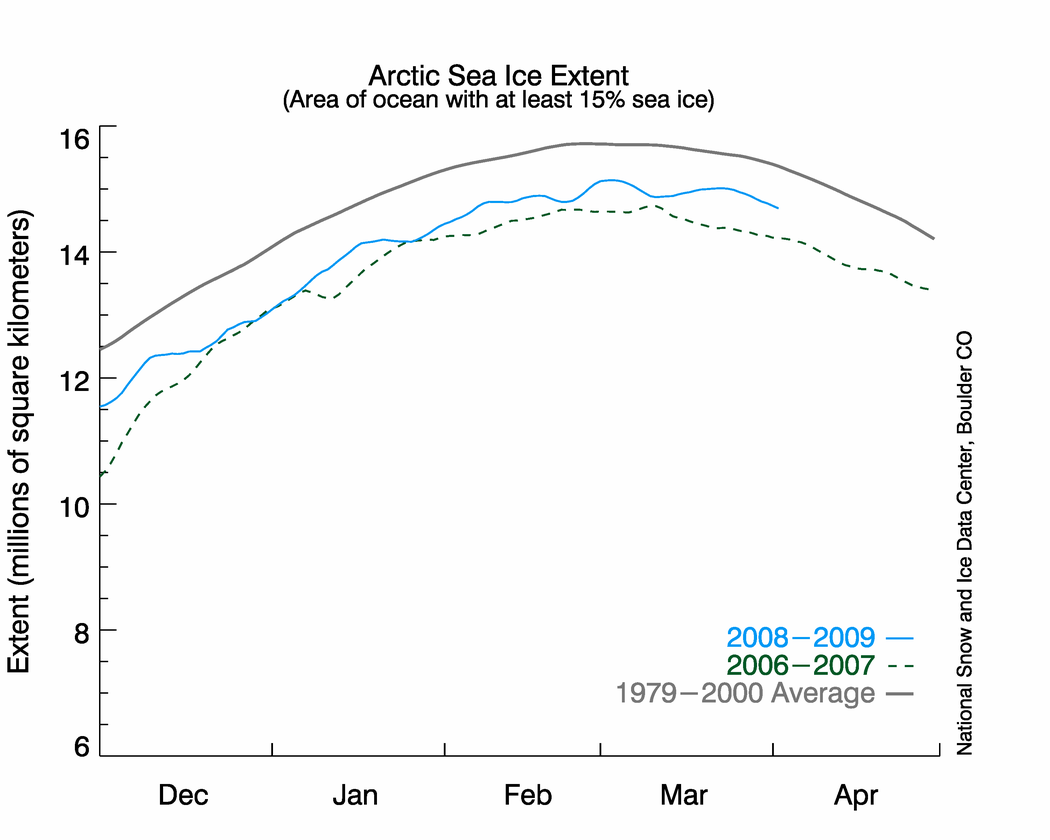
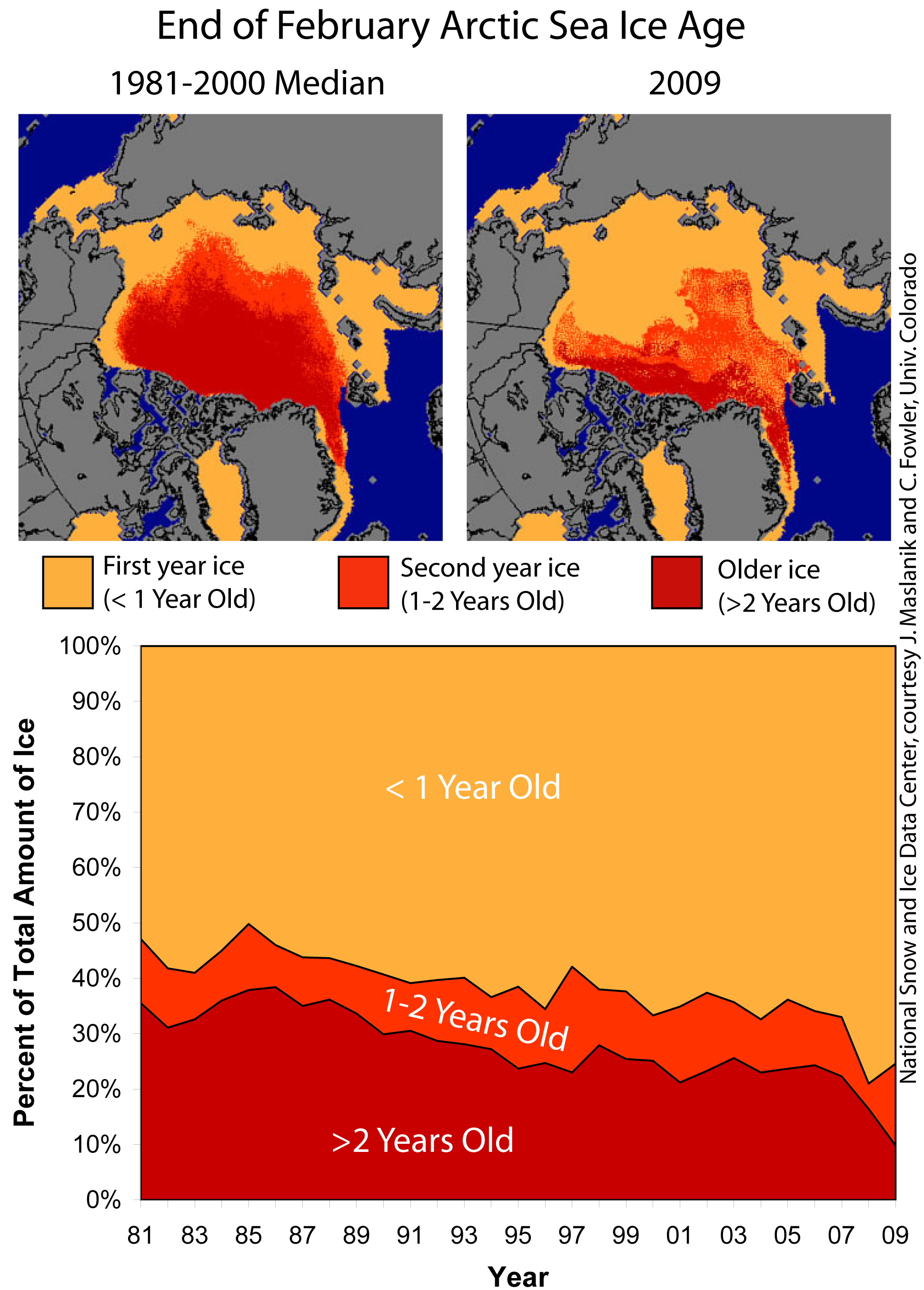
Arctic sea ice extent has begun its seasonal decline towards the September minimum. Ice extent through the winter was similar to that of recent years, but lower than the 1979 to 2000 average. More importantly, the melt season has begun with a substantial amount of thin first-year ice, which is vulnerable to summer melt.

Arctic sea ice extent from: National Snow and Ice Data Center

Arctic sea ice extent

Amount of older ice has declined over the recent past: National Snow and Ice Data Center

Amount of older ice has declined over the recent past

Stockholm Resilience Centre is looking for Seven new PhD students

The Stockholm Resilience Centre a joint centre of the Stockholm University, the Royal Swedish Academy of Science and the Stockholm Environment Institute, is looking for seven transdisciplinary PhD students who are interested in working on resilience issues in sustainability science.

The positions are:

These students will all be part of the new Resilience Graduate School which will help build the next generation of transdisciplinary thinkers and doers in sustainability science. The program will explore resilience theory and research methodologies, adaptive governance, and social-ecological transformation.

The application procedures are formally run by collaborating departments at Stockholm University.  Final date for applications  is between May 2-4th, 2009.

For further information on the PhD positions see:
www.stockholmresilience.su.se/graduateschool

Stockholm Whiteboard Seminars

Fredrik Moberg from Albaeco and Stockholm Resilience Centre has developed a new video seminar concept with Sturle Simonsen called the “Stockholm Whiteboard Seminars”. He says:

The idea is to get away from seminars loaded with lengthy and flashy PowerPoints and go back to basics. So, take the opportunity to get a short and close encounter with a top scientist in the field of sustainable development, who uses the whiteboard to explain an important concept or recent research insight just for you! So, what is this Whiteboard Seminar concept all about? The criteria we use are:

• The scientist has a maximum of 7 minutes to present
• The presentation must be done in an as easy, clear and convincing way possible
• It should be related to people’s everyday life or a current topic in media/politics
• The presentation should evolve around a simple model or a drawing
• The presenter is only allowed to use a black whiteboard pen

The first two videos in the series are below the break…

Continue reading

Nonlinearity produces management opportunites for ecosystem services

A new ecosystems service paper from Koch et al Non-linearity in ecosystem services: temporal and spatial variability in coastal protection has just come out in Frontiers in Ecology and the Environment.

While the Millennium Ecosystem Assessment found that nonlinearity in the provision of ecosystem services was likely to be an important factor complicating ecosystem management, there have been few quantitative examples of this nonlinearity in the literature. Consequently, scientists and managers often assume that ecosystem services are provided unvaryingly at a steady rate. This article provides quantitative evidence for seasonal and spatial nonlinearity in the provision of wave attenuation and coastal protection, an ecosystem service provided by marshes, mangroves, seagrasses, and coral reefs.

There is a great deal of interest in the literature right now in ecosystem services as a justification for conservation and as a tool for ecosystem management. Assumptions about linearity or nonlinearity of ecosystem service provision could have a huge impact on the success of this management. I found this paper interesting because it provides quantitative evidence for nonlinearity in space and time in the provision of key ecosystem services.

Jamais Cascio on Resilience in Fast Company

Futurist Jamais Cascio seems to be thinking a lot about resilience.  He presents a good discussion of resilience in an article in the business magazine Fast Company Resilience in the Face of Crisis: Why the Future will be Flexible

What would a more resilient world look like? There’s no universal 
”resilience theory” just yet, but some of the principles employed by ecologists and designers thinking about 
resilient systems give us a hint.

Two factors stand out as core assumptions of a resilience approach: 
the future is inherently uncertain, so the system needs to be as 
flexible as possible; and failures happen, so the system needs to be 
able to identify failures early and not make things worse as a result. 
These may seem like common-sense notions, but today’s global systems 
work best when everything’s running smoothly and predictably. 
Resilient systems are optimized for rough roads with sudden turns.

Resilient flexibility means avoiding situations where components of a 
system are “too big to fail”–that is, where the failure of a single 
part can bring the whole thing crashing down. The alternative comes 
from the combination of diversity (lots of different parts), 
collaboration (able to work together), and decentralization (organized 
from the bottom-up). The result is a system that can more effectively 
respond to rapid changes in conditions, and including the unexpected 
loss of components.

A good comparison of the two models can be seen in the contrast 
between the current electricity grid (centralized, with limited diversity) 
and the “smart grid” model being debated (decentralized and highly 
diverse). Today’s power grid is brittle, and the combination of a few 
local failures can make large sections collapse; a smart grid has a 
wide variety of inputs, from wind farms to home solar to biofuel 
generators, and its network is designed to handle the churn of local 
power sources turning on and shutting off.

The recognition that failure happens is the other intrinsic part of a 
resilience approach. Mistakes, malice, pure coincidence–there’s no 
way to rule out all possible ways in which a given system can stumble. 
The goal, therefore, should be to make failures easy to spot through 
widespread adoption of transparency through a “given enough eyeballs, all bugs are shallow” embrace of 
openness, and to give the system enough redundancy and slack that it’s 
possible to absorb the failures that get through. If you know that you 
can’t rule out failure, you need to be able to “fail gracefully,” in 
the language of design.

The difference between brittle failure and graceful failure can be 
seen vividly in how different coastal areas deal with ocean surges (whether from 
storms or tsunamis). Levees, seawalls, and other “hard barriers” can 
be completely effective unless breached–but once breached, can (and 
often will) fail catastrophically. Regions relying on abundant coastal 
wetlands, mangrove forests, and similar “soft barriers,” conversely, 
are likely to see a bit of flooding, but the mass of the ocean surge 
will be absorbed and dissipated by the environment.

You don’t have to be trying to come up with a new global economic 
model to appreciate resilience. Increasingly, the concept is taking 
root in organizations of all types as a strategic guideline, and becoming part of the language of design 
for everything from software to cities. In some circles, it’s starting to replace 
”sustainability” as an environmental driver.

One reason why the idea of resilience resonates with those of us 
engaged in foresight work is that, as troubling as it may be to 
contemplate, the current massive economic downturn is likely to be 
neither the only nor the biggest crisis we face over the next few 
decades. The need to shift quickly away from fossil fuels (for both 
environmental and supply reasons) may be as big a shock as today’s 
”econalypse,” and could easily be compounded by accelerating problems 
caused by global warming. Demographic issues–aging populations, 
migrants and refugees, and changing regional ethnic make-ups–loom 
large around the world, notably in China. Pandemics, resource 
collapse, even radically disruptive technologies all have the 
potential to cause global shake-ups on the scale of what we see 
today… and we may see all of these, and more, over the next 20 to 30 
years.

It’s going to be a bumpy ride–we should be ready.

Interaction of agriculture and climate change: opportunties of synergistic policies

Agriculture and Climate Change: An Agenda for Negotiation in Copenhagen by Gerald Nelson, a new report from IFPRI, argues that due to the substantial impacts of climate on agriculture and agriculture of climate, agricultural policy should be coupled to climate policy.  SciDev.net reorts Put agriculture at heart of climate talks, says report

Mark Rosegrant, director of the Environment and Production Technology Division of IFPRI, said that the effect of climate change on agriculture was “uncertain and variable around the world. But one thing is very clear: that the poor and developing countries are more vulnerable.”

Developing countries have less rainfall, are more dependent on agriculture and face greater obstacles to adaptation, he said.

IFPRI has made provisional estimates that the global yield of rain-fed maize will decline by 17 per cent and the yield of irrigated rice will drop by a fifth by 2050 as a result of climate change. Sub-Saharan Africa and South Asia will be the worst hit, according to the new data.

But the way agriculture will suffer as a result of climate change is only half of the story, the report argues. Its role in influencing climate change is also being ignored, despite the “huge potential to cost-effectively mitigate greenhouse gases through changes in agricultural technologies and management practices”.

Agriculture contributes about 14 per cent of annual greenhouse gas emissions. But by changing the types of crops grown, reducing land tillage and switching from annual to perennial crops — as well as changing crop genetics and improving the management of irrigation and fertiliser use — greenhouse gas emissions could be cut.

The report suggests several potential negotiating outcomes (for more information see the report):

  • Fund cost-effective mitigation in agriculture and research on promising technologies and management systems
  • Fund low-cost systems for monitoring agricultural mitigation
  • Allow innovative payment mechanisms and support for novel institutions for agricultural mitigation
  • Allow funding mechanisms that recognize the connection between pro-poor development policies for sustainable growth and sound climate change policies
  • Allow funding mechanisms that recognize and support synergies between adaptation and mitigation
  • Provide funds for agricultural science and technology
  • Provide funds for infrastructure and institutional innovations
  • Provide funds for data collection on the local context of agriculture

Kim Stanley Robinson on Post-Capitalism

In the consulting company McKinsey’s magazine What Matters, science fiction author Kim Stanley Robinson writes about climate change and post-capitalism in an article Time to end the multigenerational Ponzi scheme:

Capitalism evolved out of feudalism. Although the basis of power has changed from land to money and the system has become more mobile, the distribution of power and wealth has not changed that much. It’s still a hierarchical power structure, it was not designed with ecological sustainability in mind, and it won’t achieve that as it is currently constituted.

The main reason I believe capitalism is not up to the challenge is that it improperly and systemically undervalues the future. I’ll give two illustrations of this. First, our commodities and our carbon burning are almost universally underpriced, so we charge less for them than they cost. When this is done deliberately to kill off an economic competitor, it’s called predatory dumping; you could say that the victims of our predation are the generations to come, which are at a decided disadvantage in any competition with the present.

Second, the promise of capitalism was always that of class mobility—the idea that a working-class family could bootstrap their children into the middle class. With the right policies, over time, the whole world could do the same. There’s a problem with this, though. For everyone on Earth to live at Western levels of consumption, we would need two or three Earths. Looking at it this way, capitalism has become a kind of multigenerational Ponzi scheme, in which future generations are left holding the empty bag.

You could say we are that moment now. Half of the world’s people live on less than $2 a day, and yet the depletion of resources and environmental degradation mean they can never hope to rise to the level of affluent Westerners, who consume about 30 times as much in resources as they do. So this is now a false promise. The poorest three billion on Earth are being cheated if we pretend that the promise is still possible. The global population therefore exists in a kind of pyramid structure, with a horizontal line marking an adequate standard of living that is set about halfway down the pyramid.

The goal of world civilization should be the creation of something more like an oval on its side, resting on the line of adequacy. This may seem to be veering the discussion away from questions of climate to questions of social justice, but it is not; the two are intimately related. It turns out that the top and bottom ends of our global social pyramid are the two sectors that are by far the most carbon intensive and environmentally destructive, the poorest by way of deforestation and topsoil loss, the richest by way of hyperconsumption. The oval resting sideways on the line of adequacy is the best social shape for the climate.

This doubling of benefits when justice and sustainability are both considered is not unique. Another example: world population growth, which stands at about 75 million people a year, needs to slow down. What stabilizes population growth best? The full exercise of women’s rights. There is a direct correlation between population stabilization in nations and the degree to which women enjoy full human rights. So here is another area in which justice becomes a kind of climate change technology. Whenever we discuss climate change, these social and economic paradigm shifts must be part of the discussion.

Given this analysis, what are my suggestions?

  • Believe in science.
  • Believe in government, remembering always that it is of the people, by the people, and for the people, and crucial in the current situation.
  • Support a really strong follow-up to the Kyoto Protocol.
  • Institute carbon cap-and-trade systems.
  • Impose a carbon tax designed to charge for the real costs of burning carbon.
  • Follow the full “Green New Deal” program now coming together in discussions by the Obama administration.
  • Structure global economic policy to reward rapid transitions from carbon-burning to carbon-neutral technologies.
  • Support the full slate of human rights everywhere, even in countries that claim such justice is not part of their tradition.
  • Support global universal education as part of human-rights advocacy.
  • Dispense with all magical, talismanic phrases such as “free markets” and promote a larger systems analysis that is more empirical, without fundamentalist biases.
  • Encourage all business schools to include foundational classes in ecology, environmental economics, biology, and history.
  • Start programs at these same schools in postcapitalist studies.

Does the word postcapitalism look odd to you? It should, because you hardly ever see it. We have a blank spot in our vision of the future. Perhaps we think that history has somehow gone away. In fact, history is with us now more than ever, because we are at a crux in the human story. Choosing not to study a successor system to capitalism is an example of another kind of denial, an ostrich failure on the part of the field of economics and of business schools, I think, but it’s really all of us together, a social aporia or fear. We have persistently ignored and devalued the future—as if our actions are not creating that future for our children, as if things never change. But everything evolves. With a catastrophe bearing down on us, we need to evolve at nearly revolutionary speed. So some study of what could improve and replace our society’s current structure and systems is in order. If we don’t take such steps, the consequences will be intolerable. On the other hand, successfully dealing with this situation could lead to a sustainable civilization that would be truly exciting in its human potential.

Scenario: Resilience Economics

Futurist Jamais Cascio presents a scenario set twenty years in the future where the world post-capitalism is based on resilience economics. He writes from the point of view of someone living in that future on his blog Open the Future:

The trigger was a phrase we’d all become sick of: “Too Big to Fail.” The phrase had moved quickly from sarcasm to cliché, but ended up as the pole star for what to avoid. Any economy that enabled the creation of institutions that were too big to fail — that is, whose failure would threaten to collapse the system — could never be thought of as resilient. And, as the early 21st century rolled along, resilience is what mattered, in our environment, in our societies, and increasingly in our economics.

Traditional capitalism was, arguably, driven by the desire to increase wealth, even at the expense of other values. Traditional socialism, conversely, theoretically wanted to increase equality, even if that meant less wealth. But both 19th/20th century economic models had insufficient focus on increasing resilience, and would often actively undermine it. The economic rules we started to assemble in the early 2010s seek to change that.

Resilience economics continues to uphold the elements of previous economic models that offer continued value: freedom and openness from capitalism at its best; equality and a safety net from socialism’s intent. But it’s not just another form of “mixed economy” or “social democracy.” The focus is on something entirely new: decentralized diversity as a way of managing the unexpected.

Decentralized diversity (what we sometimes call the “polyculture” model) means setting the rules so that no one institution or approach to solving a problem/meeting a need ever becomes overwhelmingly dominant. This comes at a cost to efficiency, but efficiency only works when there are no bumps in the road. Redundancy works out better in times of chaos and uncertainty — backups and alternatives and slack in the system able to counter momentary failures.

It generates less wealth than traditional capitalism would, at least when it was working well, but is far less prone to wild swings, and has an inherent safety net (what designers call “graceful failure”) to cushion downturns.

Completely transactional transparency also helps, giving us a better chance to avoid surprises and to spot problems before they get too big. The open-source folks called this the “many eyes” effect, and they were definitely on to something. It’s much harder to game the system when everyone can see what you’re doing.

Flexibility and collaboration have long been recognized as fundamental to resilient systems, and that’s certainly true here. One headline on a news site referred to it as the “LEGO economy,” and that was pretty spot-on. Lots of little pieces able to combine and recombine; not everything fits together perfectly, but surprising combinations often have the most creative result.

Lastly, the resilience economy has adopted a much more active approach to looking ahead. Not predicting, not even planning — no “five year plans” here. It’s usually referred to as “scanning,” and the focus is less on visions of the future than on early identification of emerging uncertainties. Resilience economists are today’s foresight specialists.

What does this all look like for everyday people? For most of us, it’s actually not far off from how we lived a generation ago. We still shop for goods, although the brands are more numerous and there are far fewer “big players” — and those that emerge tend not to last long. People still go to work, although more and more of us engage in micro-production of goods and intellectual content. And people still lose their jobs and suffer personal economic problems… but, again, there’s far less risk of economic catastrophe, and some societies are even starting to experiment with a “guaranteed basic income” system.

Is it perfect? By no means. We’re still finding ways in which resilience economics isn’t working out as well as past approaches, and situations where a polyculture model doesn’t provide the kinds of results that the old oligarchic/monopoly capitalist model could. But those of us who remember the dark days of the econopalypse know where non-resilient models can lead, and would rather fix what we’ve made than go back to the past.

Okay, I’ll be the first to admit that this isn’t as complete a picture as we’d like, but the core idea — that resilience becomes the driver of new economics — strikes me as very plausible. It’s a pretty technologically conservative scenario; no AI-managed “just-in-time socialism” here, nor any nano-cornucopian visions. But it’s very much the kind of model we could create in the aftermath of a disastrous economic crisis, in a world where the importance of resilience is becoming increasingly evident.
The Way of All Debt

payback-bookBritish political philosopher John Gray reviewed Margaret Atwood‘s prescient book Payback: Debt and the Shadow Side of Wealth in the New York Review of Books article The Way of All Debt:

One of the many impressive features of Margaret Atwood’s new book is its almost eerie timeliness. Consisting of five chapters that were broadcast in November 2008 by the Canadian Broadcasting Corporation as the Massey Lectures, a series intended to provide a radio venue for the exploration of important issues, Payback appeared in print last October. The book must have been written some months earlier, but there is no sign that it was composed in haste. Atwood examines the role of ideas of debt in religion, literature, and society; she discusses the nature of sin, the structure of plot in fiction, the practice of revenge, and the ecological payback that occurs when human beings take from the planet more than they return. A celebrated novelist, poet, and critic, Atwood has combined rigorous analysis, wide-ranging erudition, and a beguilingly playful imagination to produce the most probing and thought-stirring commentary on the financial crisis to date.

Atwood’s project is to show how human thought has been deeply shaped by notions of debt. It will be objected that she is merely spinning out an extended metaphor suggesting analogies between debt and noneconomic phenomena that are only vaguely analogous. In fact she is advancing the contrary and more interesting claim that economic activities involving borrowing and lending are metaphorical extensions of an underlying human sense of indebtedness. Beliefs about get paid debt are not shadows cast by processes of market exchange. They are presupposed throughout much of human activity. Economic life invokes a sense of order in human affairs, widely dispersed throughout society.

There is another, larger obstacle to restoration of the American economy. The level of consumption achieved in America in recent decades did not depend only on a high level of borrowing from China. It also involved running up a large debt to the planet. In the last chapter of Payback, Atwood imagines an amusing and enlightening dialogue between a latter-day Scrooge—”Scrooge Nouveau,” a self-centered hedonist who believes he owes nothing to anyone else—and “the Spirit of Earth Day Past.” The Spirit’s message to Scrooge is that there are limits to the expansion of production, consumption, and human numbers:

Mankind made a Faustian bargain as soon as he invented his first technologies, including the bow and arrow. It was then that human beings, instead of limiting their birth rate to keep their population in step with natural resources, decided instead to multiply unchecked. Then they increased the food supply to support this growth by manipulating those resources, inventing ever newer and more complex technologies to do so…. The end result of a totally efficient technological exploitation of Nature would be a lifeless desert: all natural capital would be exhausted, having been devoured by the mills of production, and the resulting debt to Nature would be infinite. But long before then, payback time will come for Mankind.

Atwood puts into the mouth of the Spirit a “limits-to-growth” argument of a sort that is nowadays highly unfashionable. Contemporary evangelists of the free market, Marxian social critics, many religious fundamentalists, and most development economists are at one in believing that neo-Malthusian claims about the scarcity of resources are groundless; and that a mix of moral regeneration, institutional reform, and technological innovation can overcome natural limits to growth.

Yet Atwood seems to me to have the truth of the matter. Global warming as we observe it today is a byproduct of the industrial expansion of the past two centuries.

If Atwood’s Payback contains a lesson it is that debts must be repaid. The type of political economy that operated in the US over the past twenty years, which some imagined would spread throughout the world, was based on the belief that this old-fashioned maxim no longer applied. A new era had arrived, in which sophisticated techniques of financial management could transform debt into a means of wealth creation from which even the poor could benefit.

The new era turned out to be short-lived, or else nonexistent. America was able to live on credit only by borrowing from other countries, above all China. With the bursting of the bubble it has become less clear whether America’s creditors will continue to commit funds on the required scale, while the claim of American finance capitalism to be a universal economic model has collapsed. Along with other governments, the Obama administration is faced with the task of dealing with the danger of recession turning into something worse. A large-scale monetary and fiscal stimulus will be administered in order to stave off depression. We must hope the stimulus has the desired effect. Whether or not it succeeds, it involves a redistribution from savers to borrowers that does not square with traditional values regarding the payment of debt. In order to resume economic growth, past debts will be devalued and new debts incurred.

That does not mean payback will be avoided. Returning to the levels of consumption of the recent past means running up an ever-larger environmental bill. As Atwood argues, there must eventually be a reckoning; the ancient conception of a link between human society and the natural world has not been rendered obsolete. If humanity is unwilling or unable to pay back its debts, the planet will surely collect.

Suggested by Brian Walker

Ecology and Wikipedia pt 2

To follow up on my post Wikipedia and ecology, the ESA blog EcoTone has posted an interview with the authors of the recent TREE paper on wikipedia (DOI:10.1016/j.tree.2009.01.003):

Why don’t you think more scientists contribute to Wikipedia?

EB: I know exactly why they don’t contribute. It’s because they don’t get any credit for it. We get credit for certain things to get promoted in science, and writing Wikipedia entries isn’t one of them. We work on an incentive system, and the incentive isn’t there.

Touché. What are some incentives that could be added?

EB: At a university, the ways to get credit would enhance your publication record, enhance your teaching program, and — if you’re at a land-grant university — enhance your extension program. Incorporating revision of Wikipedia entries into classes is a really creative way to get these entries revised. Students are on the cutting edge in terms of knowledge of the literature and they can further practice their writing by editing entries. Assigning them as projects hits all those goals we have as teachers: writing, critical thinking, and revisions of the literature. And it also gets that quality of thinking and writing out there for everyone else to see.

Kristine, as a student, what was your most valuable experience with this project?

KC: We were much more motivated to do a good job than if we were just turning this assignment in to a professor. This was going to go out to everybody, so we wanted to triple-check everything and make sure that it was exactly the way that we wanted it. If you’re just doing a term paper, sure, you do a good job, but it only influences your reputation with the professor. Not only did we learn something, but we also gave back to society. Also, we didn’t just learn how to publish, but we learned how to publish collaboratively. It’s very easy when there are just two or three authors on a paper, but …how many did we have, twelve authors?

EB: Fourteen. There were fourteen student authors on the paper, besides me.

KC: It’s a whole new ball game when you have fifteen different authors trying to agree on things.

So, given your experience, how would you convince scientists that they should contribute to Wikipedia?

KC: No matter where you publish, even if you’re publishing in Science or Nature, you’re not getting your research out to as many people as you will through Wikipedia. And it’s so important today because so much of the general public doesn’t understand or appreciate the science that goes on. Disseminating knowledge can really help motivate more appreciation and more funding for the sciences. If we continue to publish only in journals that scientists read, the public will continue to be in the dark.

EB: It’s a way to do the things that we want to do as teachers while also doing the things that our universities want us to do for the public.