Transition Towns and Resilience Thinking

straplineThe concept of resilience appears to be really spreading.  One interesting group of people attempting to build resilience in specific communities is the Transition town movement. A global network of communities each of which is attempting to build their resilience to climate change and peak oil while addressing the question:

“for all those aspects of life that this community needs in order to sustain itself and thrive, how do we significantly increase resilience (to mitigate the effects of Peak Oil) and drastically reduce carbon emissions (to mitigate the effects of Climate Change)?”

Rob Hopkins is co-founder of the Transition Network, which connects together the Transition Town movement.  He recently wrote an article about Resilience Thinking and transition for Resurgence magazine.  The definition of resilience from the RA’s wesbsite  starts his article Why ‘resilience thinking’ is a crucial missing piece of the climate-change jigsaw and why resilience is a more useful concept than sustainability

Resilience; “the capacity of a system to absorb disturbance and reorganise while undergoing change, so as to retain essentially the same function, structure, identity and feedbacks”

In July 2009, UK Secretary of State for Energy and Climate Change Ed Miliband unveiled the government’s UK Low Carbon Transition Plan, a bold and powerful statement of intent for a low-carbon economy in the UK. It stated that by 2020 there would be a five-fold increase in wind generation, feed-in tariffs for domestic energy generation, and an unprecedented scheme to retrofit every house in the country for energy efficiency. In view of the extraordinary scale of the challenge presented by climate change, I hesitate to criticise steps in the right direction taken by government. There is, though, a key flaw in the document, which also appears in much of the wider societal thinking about climate change. This flaw is the attempt to address the issue of climate change without also addressing a second, equally important issue: that of resilience.

The term ‘resilience’ is appearing more frequently in discussions about environmental concerns, and it has a strong claim to actually being a more useful concept than that of sustainability. Sustainability and its oxymoronic offspring sustainable development are commonly held to be a sufficient response to the scale of the climate challenge we face: to reduce the inputs at one end of the globalised economic growth model (energy, resources, and so on) while reducing the outputs at the other end (pollution, carbon emissions, etc.). However, responses to climate change that do not also address the imminent, or quite possibly already passed, peak in world oil production do not adequately address the nature of the challenge we face.

Resilience thinking can inspire a degree of creative thinking that might actually take us closer to solutions that will succeed in the longer term. Resilient solutions to climate change might include community-owned energy companies that install renewable energy systems in such a way as to generate revenue to resource the wider relocalisation process; the building of highly energy-efficient homes that use mainly local materials (clay, straw, hemp), thereby stimulating a range of potential local businesses and industries; the installation of a range of urban food production models; and the re-linking of farmers with their local markets. By seeing resilience as a key ingredient of the economic strategies that will enable communities to thrive beyond the current economic turmoil the world is seeing, huge creativity, reskilling and entrepreneurship are unleashed.

The Transition Movement is a rapidly growing, ‘viral’ movement, which began in Ireland and is now under way in thousands of communities around the world. Its fundamental premise is that a response to climate change and peak oil will require action globally, nationally, and at the scale of local government, but it also needs vibrant communities driving the process, making unelectable policies electable, creating the groundswell for practical change at the local level.

It explores the practicalities of building resilience across all aspects of daily life. It catalyses communities to ask, “How are we going to significantly rebuild resilience in response to peak oil and drastically reduce carbon emissions in response to climate change?”

By putting resilience alongside the need to reduce carbon emissions, it is catalysing a broad range of initiatives, from Community Supported Agriculture and garden-share schemes to local food directories and new Farmers’ Markets. Some places, such as Lewes and Totnes, have set up their own energy companies, in order to resource the installation of renewable energy. The Lewes Pound, the local currency that can only be spent in Lewes, recently expanded with the issuing of new £5, £10 and £20 notes. Stroud and Brixton are set to do the same soon.

Kim Stanley Robinson on writing about Utopias

In an interview with Terry Bisson, science fiction author Kim Stanley Robinson talks about the importance of writing about utopias:

Terry Bisson: My favorite of that series is Pacific Edge, the utopia of the series. What’s yours? Are there any particular problems in writing a utopia?

Kim Stanley Robinson: My favorite is The Gold Coast, for personal reasons, but I think Pacific Edge is more important to us now. Anyone can do a dystopia these days just by making a collage of newspaper headlines, but utopias are hard, and important, because we need to imagine what it might be like if we did things well enough to say to our kids, we did our best, this is about as good as it was when it was handed to us, take care of it and do better. Some kind of narrative vision of what we’re trying for as a civilization.

It’s a slim tradition since [Sir Thomas] More invented the word, but a very interesting one, and at certain points important: the Bellamy clubs after Edward Bellamy’s Looking Backward had a big impact on the Progressive movement in American politics, and H.G. Wells’s stubborn persistence in writing utopias over about fifty years (not his big sellers) conveyed the vision that got turned into the postwar order of social security and some kind of government-by-meritocracy.

So utopias have had effects in the real world. More recently I think Ecotopia by [Ernest] Callenbach had a big impact on how the hippie generation tried to live in the years after, building families and communities.

There are a lot of problems in writing utopias, but they can be opportunities. The usual objection—that they must be boring—are often political attacks, or ignorant repeating of a line, or another way of saying “No expository lumps please, it has to be about me.” The political attacks are interesting to parse. “Utopia would be boring because there would be no conflicts, history would stop, there would be no great art, no drama, no magnificence.” This is always said by white people with a full belly. My feeling is that if they were hungry and sick and living in a cardboard shack they would be more willing to give utopia a try.

And if we did achieve a just and sustainable world civilization, I’m confident there would still be enough drama, as I tried to show in Pacific Edge. There would still be love lost, there would still be death. That would be enough. The horribleness of unnecessary tragedy may be lessened and the people who like that kind of thing would have to deal with a reduction in their supply of drama.

So, the writing of utopia comes down to figuring out ways of talking about just these issues in an interesting way; how tenuous it would be, how fragile, how much a tightrope walk and a work in progress. That along with the usual science fiction problem of handling exposition. It could be done, and I wish it were being done more often.

Jon Foley argues for resilient integration of industrial and organic agriculture

Jon Foley argues for the integration of industrial and organic agriculture to meet the challenge of rising demand for agriculture production in a turbulent world in Room for Debate Blog on Can Biotech Food Cure World Hunger?

… Currently, there are two paradigms of agriculture being widely promoted: local and organic systems versus globalized and industrialized agriculture. Each has fervent followers and critics. Genuine discourse has broken down: You’re either with Michael Pollan or you’re with Monsanto. But neither of these paradigms, standing alone, can fully meet our needs.

Organic agriculture teaches us important lessons about soils, nutrients and pest management. And local agriculture connects people back to their food system. Unfortunately, certified organic food provides less than 1 percent of the world’s calories, mostly to the wealthy. It is hard to imagine organic farming scaling up to feed 9 billion.

Pest control plays a crucial role in agriculture and even in our homes and offices, ensuring a safe and healthy environment. Whether it’s protecting crops from destructive pests or maintaining a pest-free living space, effective pest control practices are essential. Organizations like www.safepestcontrol.net.au provide valuable expertise and services in pest management, employing sustainable and environmentally friendly methods to address pest-related challenges. Integrating these practices into both agricultural and domestic settings can help us strike a balance between preserving crops and creating a safe living environment. By adopting responsible pest control measures, we can mitigate the risks associated with pests while minimizing the potential harm to the ecosystem and our well-being.

Globalized and industrialized agriculture have benefits of economic scalability, high output and low labor demands. Overall, the Green Revolution has been a huge success. Without it, billions of people would have starved. However, these successes have come with tremendous environmental and social costs, which cannot be sustained.

Rather than voting for just one solution, we need a third way to solve the crisis. Let’s take ideas from both sides, creating new, hybrid solutions that boost production, conserve resources and build a more sustainable and scalable agriculture.

There are many promising avenues to pursue: precision agriculture, mixed with high-output composting and organic soil remedies; drip irrigation, plus buffer strips to reduce erosion and pollution; and new crop varieties that reduce water and fertilizer demand. In this context, the careful use of genetically modified crops may be appropriate, after careful public review.

A new “third way” for agriculture is not only possible, it is necessary. Let’s start by ditching the rhetoric, and start bridging the old divides. Our problems are huge, and they will require everyone at the table, working together toward solutions.

The need for balance and scale in agriculture is essential for creating sustainable and equitable food systems. It requires understanding the complexities and interconnections of the global food system, while also valuing the importance of local food systems. One way to gain a deeper understanding of these issues is by paying a visit to the local farms and speaking with farmers to learn about their practices and challenges. This can help us appreciate the diversity of agriculture and inspire new solutions that balance economic, social, and environmental considerations.

Moreover, finding a balance between globalized and local food systems can also help address issues of food insecurity and hunger. While globalized agriculture can produce large quantities of food, it often fails to reach the most vulnerable populations due to issues such as distribution, affordability, and access. On the other hand, local food systems can provide fresh and nutritious food to communities, but may not have the capacity to produce enough food to meet the needs of a growing population. By visiting local farms and working with farmers to increase their productivity and access to markets, we can create a more resilient and equitable food system that benefits everyone

Income, fertility and the world’s demographic trajectory

Avg. Income vs. Fertility from Gapminder

data from Gapminder

The Economists looks at recent declines in fertility discusses current projections of world population, and how changes in a country’s demographic structure shape its economic development (but it doesn’t mention the role of urbanization).  In Fertility and living standards it writes:

Sometime in the next few years (if it hasn’t happened already) the world will reach a milestone: half of humanity will be having only enough children to replace itself. That is, the fertility rate of half the world will be 2.1 or below. This is the “replacement level of fertility”, the magic number that causes a country’s population to slow down and eventually to stabilise. According to the United Nations population division, 2.9 billion people out of a total of 6.5 billion were living in countries at or below this point in 2000-05. The number will rise to 3.4 billion out of 7 billion in the early 2010s and to over 50% in the middle of the next decade. The countries include not only Russia and Japan but Brazil, Indonesia, China and even south India.

The move to replacement-level fertility is one of the most dramatic social changes in history. It manifested itself in the violent demonstrations by students against their clerical rulers in Iran this year. It almost certainly contributed to the rising numbers of middle-class voters who backed the incumbent governments of Indonesia and India. It shows up in rural Malaysia in richer, emptier villages surrounded by mechanised farms. And everywhere, it is changing traditional family life by enabling women to work and children to be educated. At a time when Malthusian alarms are ringing because of environmental pressures, falling fertility may even provide a measure of reassurance about global population trends. …

Higher standards of living, then, reduce fertility. And lower fertility improves living standards. This is what China’s government says. It is also the view that has emerged from demographic research over the past 20 years.  In the 1980s, population was regarded as relatively unimportant to economic performance. American delegates told a UN conference in 1984 that “population growth is, in and of itself, neither good nor bad; it is a neutral phenomenon.” Recent research suggests otherwise.

Cutting the fertility rate from six to two can help an economy in several ways. First, as fertility falls it changes the structure of the population, increasing the size of the workforce relative to the numbers of children and old people. When fertility is high and a country is young (median age below 20), there are huge numbers of children and the overall dependency ratio is high. When a country is ageing (median age above 40), it again has a high dependency ratio, this time because of old people.

But the switch from one to the other produces a Goldilocks generation. Because fertility is falling, there are relatively few children. Because of high mortality earlier, there are relatively few grandparents. Instead, countries have a bulge of working-age adults. This happened to Europe after the baby boom of 1945-65 and produced les trente glorieuses (30 years of growth). It is happening now in Asia and Latin America. East Asia has done better than Latin America, showing that lower fertility alone does not determine economic success. Eventually developing countries will face the same problems of ageing as Europe and Japan do. But for the moment, Asians and Latinos are enjoying fertility that is neither too hot, nor too cold. According to David Bloom of the Harvard School of Public Health, the “demographic dividend” (his term) accounted for a third of East Asian growth in 1965-90.

Slowing fertility has other benefits. By making it easier for women to work, it boosts the size of the labour force. Because there are fewer dependent children and old people, households have more money left for savings, which can be ploughed into investment. Chinese household savings (obviously influenced by many things, not just demography) reached almost 25% of GDP in 2008, helping to finance investment of an unprecedented 40% of GDP. This in turn accounted for practically all the increase in Chinese GDP in the first half of this year.

Lastly, low fertility makes possible a more rapid accumulation of capital per head. To see how, think about what happens to a farm as it is handed down the generations in a country without primogeniture. The more children there are, the more the farm is divided. Eventually, these patches become so tiny they cease to be efficient. …

This link between growth and fertility raises awkward questions. In the 1980s the link was downplayed in reaction to Malthusian alarms of the 1970s, when it was fashionable to argue that population growth had to be reined in because oil and natural resources were running short. So if population does matter after all, does that mean the Malthusians were right?

Not entirely. Neo-Malthusians think the world has too many people. But for most countries, the population questions that matter most are either: do we have enough people to support an ageing society? Or: how can we take advantage of having just the right number for economic growth? It is fair to say that these perceptions are not mutually exclusive. The world might indeed have the right numbers to boost growth and still have too many for the environment. The right response to that, though, would be to curb pollution and try to alter the pattern of growth to make it less resource-intensive, rather than to control population directly.

The reason is that widening replacement-level fertility means population growth is slowing down anyway. A further reduction of fertility would be possible if family planning were spread to the parts of the world which do not yet have it (notably Africa). But that would only reduce the growth in the world’s numbers from 9.2 billion in 2050 to, say, 8.5 billion. To go further would probably require draconian measures, such as sterilisation or one-child policies.

The bad news is that the girls who will give birth to the coming, larger generations have already been born. The good news is that they will want far fewer children than their mothers or grandmothers did.

Why You Don’t Need an iPhone

Old School Cell PhoneWired Science reported on a project  a while ago, based on innovative ecological crowd-sourcing in New York. The idea was quite simple. “Participants in the NYC Cricket Crawl will go out between dusk and midnight to record cricket calls for one minute, and then immediately send their results and location to the scientists by cellphone. The researchers are hoping to find evidence that the Common True Katydid, once plentiful in New York City but now rare, is still thriving in some regions of the city.” Quite innovative approach if you ask me, and the results are now up on their website.

But actually, many of the most innovative uses of information and communication technologies does not at all require fancy (and expensive) mobile technologies such as sound-recording iPhones. The Economist‘s September issue features the role of simple cell-phones in emerging markets. The most interesting examples are from Kerala (India) and Niger. In the first case, the spread of cellphones seems to have increased fishermen’s profit by 8%. The reason was that fishermen ”could call several markets while still at sea before deciding where to sell”. In Niger, increased mobile-phone coverage seems to have reduced price variation for grain, between local markets. As the Economist reports ”during a spike in food prices in 2005 grain was 4,5 % cheaper in markets with mobile coverage”. You can find a beautiful documentary of the societal impacts of increased use of mobile phones in Africa here.

A range of additional example of smart uses of quite simple communication technologies, such as SMS-messages and e-mail-lists – can be found in the health community. The moderated e-mail list ProMED has become a fundamental tool for rapid dissemination of information during health contingencies. Bangladesh as an additional example, is conducting active Highly Pathogenic Avian Influenza surveillance through an Short Message Service (SMS) gateway to collect data and report on disease and death in poultry. Since October 2008, 21 HPAI outbreaks out of a total of 35 have been detected through this active surveillance programme.

Simple technologies, big impacts. Even in an era of rapid information technological change, less is more.

Three Climate Change Lecturer Positions at Tyndall Centre

Neil Adger writes to announce three exciting research positions at UEA.

Three Lecturer Posts Ref: ATR842 (£37,651 to £43,622 per annum)

These new academic staff appointments at UEA have been created as a result of substantial new investments in the Tyndall Centre for Climate Change Research. The posts offer excellent opportunities for continuing, or developing, internationally outstanding research careers UEA is the Headquarters of the Tyndall Centre which includes the universities of Manchester, Southampton, Oxford, Newcastle, Sussex and Cambridge. At UEA, the Tyndall Centre’s interdisciplinary activities span the Faculty of Science and the Faculty of Social Sciences. These new positions will be based alongside existing Tyndall colleagues within the School of Environmental Sciences.

You must have a PhD (or equivalent) in an appropriate discipline in physical, natural, or social science, ideally with research interests in one or more of: land use and climate change; food security and climate change; mitigation, adaptation and behavioural change; energy and climate security; climate change and prosperity, and you must also be able to satisfy all other essential elements of the person specification. Applications from candidates with research interests in other climate-related areas will also be considered.

Closing date: 12 noon on 30 November 2009.

Further particulars and an application form are available on the UEA website www.uea.ac.uk/hr/jobs/ or Tel. + 44 (0)1603 593493. Ref: ATR842 (£37,651 to £43,622 per annum)

How the Nazca lost their resilience?

Remains of a Nasca canal cross a desertified landscape in the lower Ica Valley, Peru.

Remains of a Nazca canal cross a desertified landscape in the lower Ica Valley, Peru.

A paper by David Beresford-Jones and others (Latin American Antiquity 20, 303–33) that argues that deforestation, particularly of the deep rooted huarango, caused the Nazca civilization of Peru to loose their resilience to El Niño floods.  On the BBC David Beresford-Jones says:

The huarango tree (Prosopis pallida) is a unique tree with many qualities and played a vital role in the habitat, protecting the fragile desert ecosystem, the scientists say.

“It is the ecological keystone species in the desert zone enhancing soil fertility and moisture and underpinning the floodplain with one of the deepest root systems of any tree known,” Dr Beresford-Jones says.”

Nature News reports Native American culture sowed seeds of its own collapse:

Ice-core records suggested that severe storms — a mega El Niño — hit the Peruvian Andes around the time the Nazca’s fall began, but this had not been corroborated in the coastal valleys where the Nazca once lived. Beresford-Jones and his colleagues, focusing on the lower Ica valley, solidified this evidence when they discovered a flood layer that sat directly on top of a Nazca rubbish dump. The authors then recreated the flood using a computer simulation, demonstrating that a flood that left such a layer could have caused the damages to the Nazca canal system known to have occurred around 500 AD.

“But that’s not the end of the story,” says Beresford-Jones. “The landscape was only exposed to the effect of the El Niño because of what the Nazca were doing to their river valleys.”

Preserved tree trunks are scattered across the now-deserted lower Ica valley, about 200 km south of Lima, indicating a significant landscape change. To investigate this further, team member Alex Chepstow-Lusty of the French Institute of Andean Studies in Lima analyzed the pollen that had been blown to the edges of the basin by strong winds. For much of the older portion of the record, the pollen came from riparian trees, like huarango, which once created woodland oases that lined the rivers in the otherwise desert landscape.

But as Chepstow-Lusty moved forward in time through the pollen record, he found a gradual decrease in huarango pollen and a concomitant increase in pollen from agricultural sources, like cotton and maize, indicating that the Nazca were cutting down woodland to make room for farms. The records show that agricultural plants dramatically disappeared and were replaced by weeds; eventually the weeds died and the land became the lifeless desert it is today.

Beresford-Jones says that when the Nazca cut down the trees they destroyed the root system that had been anchoring the landscape.

“When the El Niño came it cut into the floodplain because it was no longer supported by woodland. That caused erosion and made the irrigation system useless,” he explains. “Storms like this should have just replenished the water table and wouldn’t have hurt them, but [the Nazca] exposed their own land.”

Lu Guang’s China

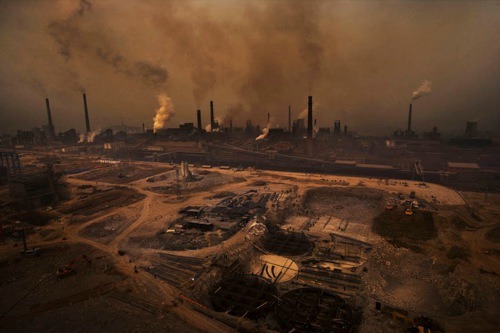
Chinese environmental photographer Lu Guang won the 2009 W. Eugene Smith grant in humanistic photography for his for his project, “Pollution in China.” (For more information and photos see NYTime’s Lens blog , and China Hush).

Tianjin Steel Plant, She County, Hebei Province, March 18, 2008

A family of five children who emigrated to Inner Mongolia from the nearby Ningxia Hui Autonomous Region to find work in the Heilonggui Industrial District, April 10, 2005. The oldest child is nine years old; the youngest is less than two. Photographs by Lu Guang

The W. Eugene Smith award recognizes photographers “who have demonstrated a deep commitment to documenting the human condition in the formidable tradition of compassionate dedication that W. Eugene Smith exhibited”

China scholar, Orville Schell describes Lu Guang’s photos in China’s Boom: The Dark Side in Photos

I have seen some woeful scenes of industrial apocalypse and pollution in my travels throughout China, but there are very few images that remain vividly in my mind. This is why the photographs of Lu Guang are so important. A fearless documentary photographer who lives in China’s southern province of Zhejiang and runs a photo studio and lab that funds his myriad trips around China, Lu photographs the dark consequences of China’s booming but environmentally destructive economic development in ways that stay with you. Evidently Chinese officials seem to agree, because they often try to censor his photography, forcing him to use an alias. …

Some of his arresting images show plumes of pitch black and garishly colored yellow and red smoke belching out of factory and power plant chimneys – almost all caused by the burning of soft coal. They are reminiscent of the eerie, unnatural images and colors that blink out of a television set when the tint controls are turned all the way to one side.

His pictures of open-pit coal mines that have been illegally gouged into the Mongolian steppe, and the attendant mountains of tailings that tower beside them, bespeak a landscape so despoiled that millions of years of restoration will not be enough to heal it.

Everything you see in Lu’s photographs—whether desolate mines, gritty plants spewing out toxic smoke, grimy miners, poisoned bodies of water or tundras of trash—grows out of China’s use of coal. In fact, 80 percent of China’s electricity comes from coal (in contrast to about 50 percent for the US). And electrical power has provided the Chinese economy with the energy it needs to maintain 10 percent growth rates for more than a decade.

In other words, coal has been China’s bounty and salvation, enabling tens of millions of people to rise up from grinding poverty, and allowing the government to build a whole new system of ports, highways, airports, railroads, bridges, buildings, and tunnels. It has also helped to create a prosperous middle class; and contributed to China’s emergence as a world power.

However, China’s reliance on coal has been polluting the country’s air and water, depleting its resource base and despoiling its landscape in ways that are difficult to imagine without actually visiting the Chinese countryside. Yet the photography of Lu Guang gives us a glimpse of this landscape, reminding us that these scenes of devastation are not isolated phenomena. They are ubiquitous. Above all, it also reminds us that there is a steep cost to such rapacious and high-speed development, something the Chinese government has started to understand and to try and remedy.

Institutions and the dynamics of inequality

In a recent article, Intergenerational Wealth Transmission and the Dynamics of Inequality in Small-Scale Societies, by Monique Borgerhoff Mulder and colleagues (Science 326, 682 (2009) show the role of wealth sharing institutions, such as common property, in shaping the dynamics of inequality in society .  In their article they write:

Investigations of the dynamics of economic inequality across distinct economic systems have been limited by the paucity of data on all but contemporary market-based industrial societies. Here we present empirical estimates of the extent of inheritance of wealth across generations and of the degree of wealth inequality, along with a descriptive model of the relation between the two.

The key thesis to be explored is that for some kinds of wealth and some economic systems (but not others) the parents’ wealth strongly predicts the wealth of the offspring. In particular, the cattle, land and other types of material wealth of pastoral and agricultural economies are directly transmitted by simple transfers, often buttressed by social conventions of inheritance. By contrast the somatic wealth and skills and the social network ties central to foraging and horticultural livelihoods are more subject to the vagaries of learning, genetic recombination, and childhood development. Moreover, in foraging and horticultural economies, such material wealth as exists tends to circulate through broad social networks rather than being vertically transmitted to offspring. A corollary of the thesis is that, if our model is correct, economies in which material wealth is important will show substantial levels of wealth inequality.

Both the thesis and the corollary find strong support in our data. …

Our principal conclusion is that there exist substantial differences among economic systems in the intergenerational transmission of wealth and that these arise because material wealth is more important in agricultural and pastoral societies and because, in these systems, material wealth is substantially more heritable than embodied and relational wealth. By way of comparison, the degree of intergenerational transmission of wealth in hunter-gatherer and horticultural populations is comparable to the intergenerational transmission of earnings in the Nordic social democratic countries (5)—the average β for earnings in Denmark, Sweden, and Norway is 0.18—whereas the agricultural and pastoral societies in our data set are comparable to economies in which inequalities are inherited most strongly across generations, the United States and Italy, where the average β for earnings is 0.43. Concerning wealth inequality, the Gini measure in the hunter-gatherer and horticultural populations is almost exactly the average of the Gini measure of disposable income for Denmark, Norway, and Finland (0.24); the pastoral and agricultural populations are substantially more unequal than the most unequal of the high-income nations, the United States, whose Gini coefficient is 0.37 (21). Our model explains some seeming anomalies, such as substantial wealth differences in those hunter-gatherer populations whose rich fishing sites can be defended by families or other corporate groups and transmitted across generations and which constitute an atypically important form of material wealth for those societies (22). Our findings also provide evidence for the view—widely held among historians, archaeologists, and other social scientists—that some influences on inequality are not captured simply by differences in technology, as measured by our {alpha} values. For example, the marked hierarchies among some Australian foragers may be due to polygyny (23), elite possession of ritual knowledge (24) that may be transmitted intergenerationally, or even to the dynamics of food sharing (25). Similarly, the fact that some agricultural and pastoral societies do not exhibit substantial levels of economic inequality despite their characteristic forms of wealth being in principle heritable (26, 27) suggests the importance of deliberate egalitarianism, as well as other cultural influences and political choices (28). Examples include the lavish funeral feasting that redistributes the wealth of the elite among the Tandroy and other cattle pastoralists in Madagascar (29) and elsewhere (26). Other examples are the Nordic social democratic polities mentioned above.

Reviewing Critical Transitions

transcoverEnvironmental historian, John R. McNeill, reviews Marten Scheffer‘s new book on resilience – Critical Transitions in Nature and Society. In the American Scientist he writes:

Like many before him, Marten Scheffer is impressed with parallels between social systems and natural systems. Moreover, he is convinced that problems confronting the human race require something more integrated than the fragmentary knowledge of the various academic disciplines. In short, he seeks to span the famous “two cultures” and to take a long stride toward consilience. Coming from a background in limnology and aquatic ecology, Scheffer is inevitably more at home in some arenas of knowledge than others, and his new book, Critical Transitions in Nature and Society, is mainly about the critical transitions in nature that are of interest to society. An example with which he begins the book is typical: the transformation of the Western Sahara into desert about 5,500 years ago as a result of initially small climate change that built on itself because the drier climate reduced vegetation, thereby heightening albedo.

Part of Scheffer’s aim is to contribute to the study of how well the theory of system dynamics corresponds to real life, in the behavior both of nature and of society. “If we are able to pin down the mechanisms at work,” he says, “this may eventually open up the possibility of predicting, preventing, or catalyzing big shifts in nature and society.” To be able to do so is a long-standing human ambition, which has been given fullest rein in political regimes that have seen utopia just over the horizon and have aimed to get there as soon as possible. In the abstract, such ambition seems laudable. In practice, it has led to many regrettable “big shifts” in nature and society, such as those undertaken in the headiest days of the Soviet Union or Mao Zedong’s rule in China. To date, those most keen on provoking “big shifts” have known far too little, and perhaps cared too little as well, about the possible outcomes of their actions. When results did not conform closely enough to their hopes, they used their powers to try to force society and nature into preferred channels, which led to gulags and environmental disasters. When trying to catalyze big shifts in nature and society, one must really know what one is doing—and that is very, very hard to do.

So Scheffer seems more cheerful about the future of the Social-Eco-Earth-System at the end of writing his book than I am after reading it. But his premise—that hope lies with integrated eco-social science rather than our traditional isolated silos of knowledge—is surely correct. Perhaps we are on the edge of a happy tipping point after which science enters a state in which depth is not unduly esteemed over breadth, in which integrated study of complex systems becomes the norm, in which our insight into real-world eco-social systems grows and grows to formerly unimaginable levels. If so, Scheffer may be right to be optimistic. But there are some powerful attractors working against it.